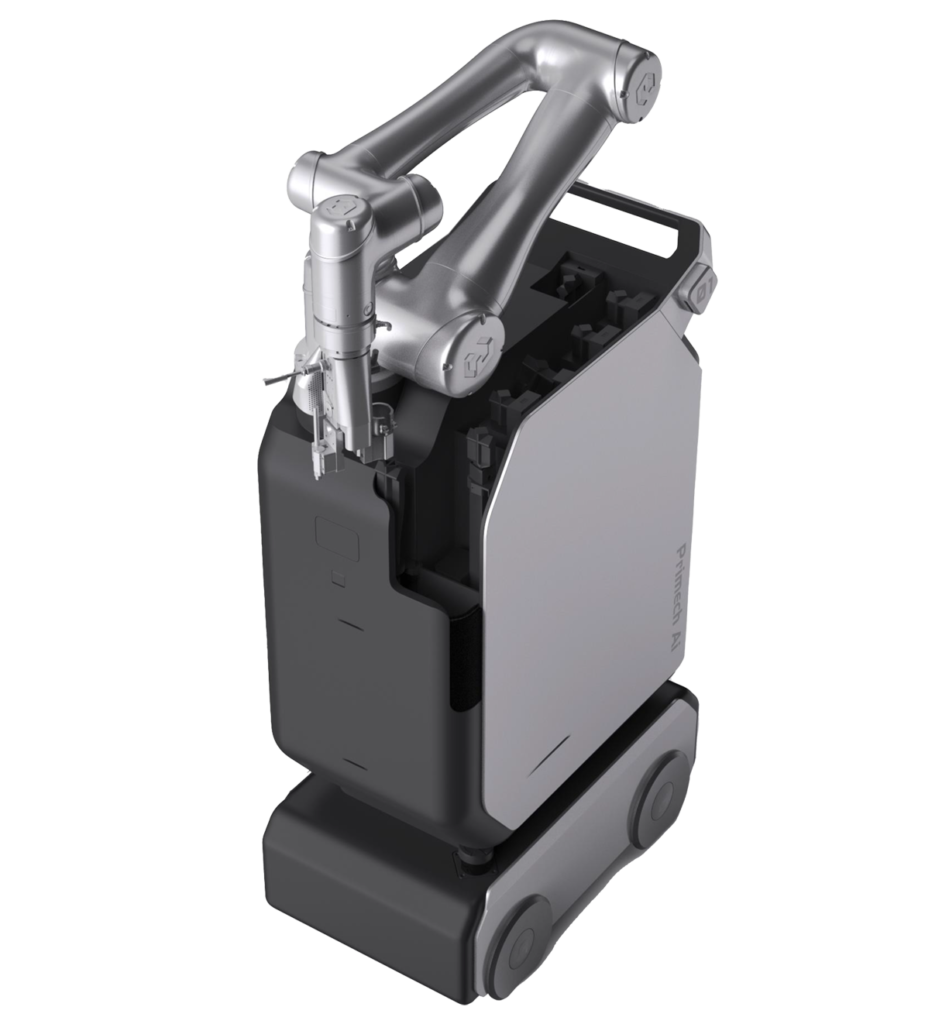
HYTRON is a bathroom cleaning robot that cleans the fixtures themselves: toilet bowls, squat toilets, urinals, sinks, countertops and mirrors, plus the floor immediately around each one.
Commercial bathrooms are cleaned by hand several times a day, fixture by fixture, so staff time per bathroom adds up. Staff keep restocking, waste removal and inspection, and in a trial at Temasek Polytechnic, staff time on the same bathroom fell from about 45 minutes to about 5.
For facility managers and facility services providers, here is what HYTRON cleans, how it moves through a shared restroom, what trials measured and what a site needs. It works fixture by fixture with a six-axis arm and rotating brushes, adjusting contact pressure to the surface it is cleaning.
Restocking, waste removal, inspection and general floor care stay with your team.


Computer vision and artificial intelligence (AI) inspect each fixture first, so a blocked or full bowl can be caught before the first flush. Sensors lift the seat and lid, electrolyzed water generated on board lifts soil and dirt without contact, and rotating brushes scrub the bowl, rim and surround with force-controlled contact, force sensors setting the pressure.
Where the facility chooses, its approved detergent or disinfectant is applied from the 0.4 US gal (1.5 L) tank with the dwell time its label sets. The fixture is rinsed and flushed, then an air blower and squeegee dry fixtures, counters, mirrors and the floor around them. Its cleaning tools (brushes, wipers and nozzles) are cleaned with electrolyzed water inside the housing before the next fixture.
A toilet takes about 6 to 10 minutes, depending on whether a Spot Clean or a Deep Clean is programmed for it, and urinals and wash basins about 3 minutes each.
The full toilet sequence is on the toilet cleaning robot page.
HYTRON is 16.1 in wide and moves sideways on Mecanum wheels, so it works between fixtures in standard stall layouts (stall doors 23 in or wider). It opens push-type stall doors, docks itself to take on fresh water, drain its dirty water and recharge, and resumes the schedule where it stopped. Bathrooms do not need to close while it works.
Four-wheel Mecanum drive lets it move sideways and diagonally without pivoting in the tight spaces between fixtures. It is suitable for stall interiors 31 in (78 cm) wide or more and thresholds up to 0.4 in (10 mm), the height tested to date. HYTRON is built for high-traffic bathrooms in airports and transport hubs, healthcare facilities, schools and universities, hotels, office buildings and commercial real estate, and the public sector.
Runs can be scheduled at any hour, inside or outside business hours, and priority and avoidance zones can be set where robots share space. HYTRON runs up to 4 hours per charge, returns to its dock on its own, recharges in about 2 hours, refills and drains, and picks up the schedule where it stopped.
HYTRON cleans the fixtures and the floor around them, so cleaning teams can focus on the jobs that still need a person: restocking, trash and waste removal, and inspection. General floor cleaning and the rest of the room stay with staff or a floor machine. It is not washdown rated (IPX2), so do not hose or jet the robot or its dock.
For cleaning operations, each task and subtask is logged with fixtures cleaned, duration, tank levels and battery state. Records reach a web dashboard over the onboard data SIM, with SMS alerts, so supervisors can monitor which fixtures were cleaned and for how long rather than assume it.
HYTRON sends operational data only, and the robot collects no personal data. A Primech API connects it to customer work-order and facility management systems.
89%In a real-world trial at Temasek Polytechnic in Singapore, staff time on the same bathroom fell from about 45 minutes to about 5.
In the same trial HYTRON cleaned 4 stalls, 3 urinals and 2 basins in about 45 minutes of unattended runtime.
Two safety laser scanners (device ratings Type 3, SIL 2, PL d), a 3D LiDAR, a collision strip and three emergency stop groups watch the space around the robot for obstacles.
The technology behind it runs on the robot: all inference runs on an NVIDIA Jetson Orin NX 16GB, up to 100 TOPS on device, so navigation, cleaning and safety continue where cellular coverage drops, and the robot does not connect to your network.
A dock location with power, a water inlet and a drain; a site survey; mapping and fixture teaching; supervised runs; then handover with a short staff orientation. Commercial terms, including supply model and service coverage, are set by territory.
The site survey plans the dock location and where to install it.
| Robot width | 16.1 in (409 mm); four-wheel Mecanum drive moves sideways and diagonally without pivoting |
|---|---|
| Stall doors | 23 in (58 cm) wide or more; HYTRON opens push-type stall doors |
| Stall interiors | 31 in (78 cm) wide or more |
| Thresholds | Up to 0.4 in (10 mm), the height tested to date |
| Entrance door | HYTRON opens push-type bathroom entrances; a heavy or stiff door may need propping open |
| Dock space | 47 x 31 in (1200 x 800 mm), 8 in clear each side, 4 in from the wall |
| Dock services | 1,500 W single-phase 220 to 240 V, 1/2 in water inlet with valve, 1/4 in drain, 1/4 in overflow |
| Environment | 41 to 104 F (5 to 40 C), under 90 percent humidity, non-condensing |
| Run and recharge | Up to 4 hours per charge; about 2 hours to recharge at the dock |
Full specifications are on the HYTRON page.
HYTRON is built by Primech AI, a Primech Holdings company (Nasdaq: PMEC). Primech AI is an NVIDIA Inception Program member, and HYTRON is supportable equipment under Singapore’s Environmental Services Productivity Solutions Grant (November 2025).
Every figure on this page comes from the HYTRON Product Specifications sheet, Rev C, November 2026.
Yes. HYTRON is an autonomous robot bathroom cleaner for commercial facilities. It cleans toilets, squat toilets, urinals, sinks, countertops, mirrors and the floor immediately around each fixture, then docks itself to refill, drain and recharge.
HYTRON’s measured result: at Temasek Polytechnic, staff time on the same bathroom fell from about 45 minutes to about 5. Each task is logged, so a site can check the work on the dashboard rather than assume it.
It opens push-type stall doors and bathroom entrances. A heavy or stiff entrance door may need propping open for the robot to enter.
No. Routes recalculate around people in real time, runs can be scheduled at any hour, and priority and avoidance zones can be set where robots share space.
HYTRON does not. It mops, squeegees and air dries the floor immediately around each fixture; general floor cleaning stays with staff or a floor machine.
After up to 4 hours of work, HYTRON returns to its dock on its own, recharges in about 2 hours, refills and drains, and resumes the schedule where it stopped.
Each task and subtask, with fixtures cleaned, duration, tank levels and battery state. Records reach a web dashboard with SMS alerts, and the robot collects no personal data.
No. Navigation, cleaning and safety run on the robot. It uses a private Wi-Fi link to its dock, not your network, carries an onboard LTE module with a data SIM, and syncs records when the connection returns.
A dock location of about 47 x 31 in with power, a water inlet and a drain; stall doors at least 23 in wide; and a site survey before installation.
Book a demonstration at your site or ours, or ask about distribution in your territory.